

Research demonstration, not clinical validation. Sleep stages are used here only as an outside label to check what the neighbours have in common.
Data and protocol
- Dataset: Sleep-EDF Expanded, sleep-cassette study, first night of subjects 0 to 19 (
SC4001toSC4191, PSG and hypnogram files). Check the downloads against PhysioNet’sSHA256SUMS.txt: a truncated EDF still opens. - Signal: the two EEG channels, Fpz-Cz and Pz-Oz, at 100 Hz as stored. Each night is cropped to 30 minutes before the first and after the last sleep epoch.
- Windows: the default stride of 30 s, so windows line up with the hypnogram’s 30 s epochs. 20,650 windows were embedded; 20,626 have a stage (W, N1, N2, N3, REM; stages 3 and 4 merged into N3). The 24 windows scored as movement or unknown are left out of the search.
- Search: cosine similarity over all labelled windows, with every window of the query’s own night masked, so neighbours always come from another subject. K = 10.
- Chance: for a query of stage s, the fraction of other-subject windows that have stage s. This is the same-stage rate of 10 neighbours drawn at random.
- Run: 10 November 2026,
neuroencoder2.1.0, hosted API, Python 3.11.
1. Embed the nights
embed_nights.py
pip install neuroencoder mne and a key (see Quickstart). The 20 nights took 1,201 s of wall time in the embedding calls (37 to 83 s per night) and billed 619,500 s, about 172 h of EEG. That is more than one trial key’s 100 h per month; with a trial key, embed 10 nights or fewer.
2. Search
similarity_search.py
t is seconds from the start of the cropped night, and night n is the n-th file in sorted order (SC4001 is night 0).
Output
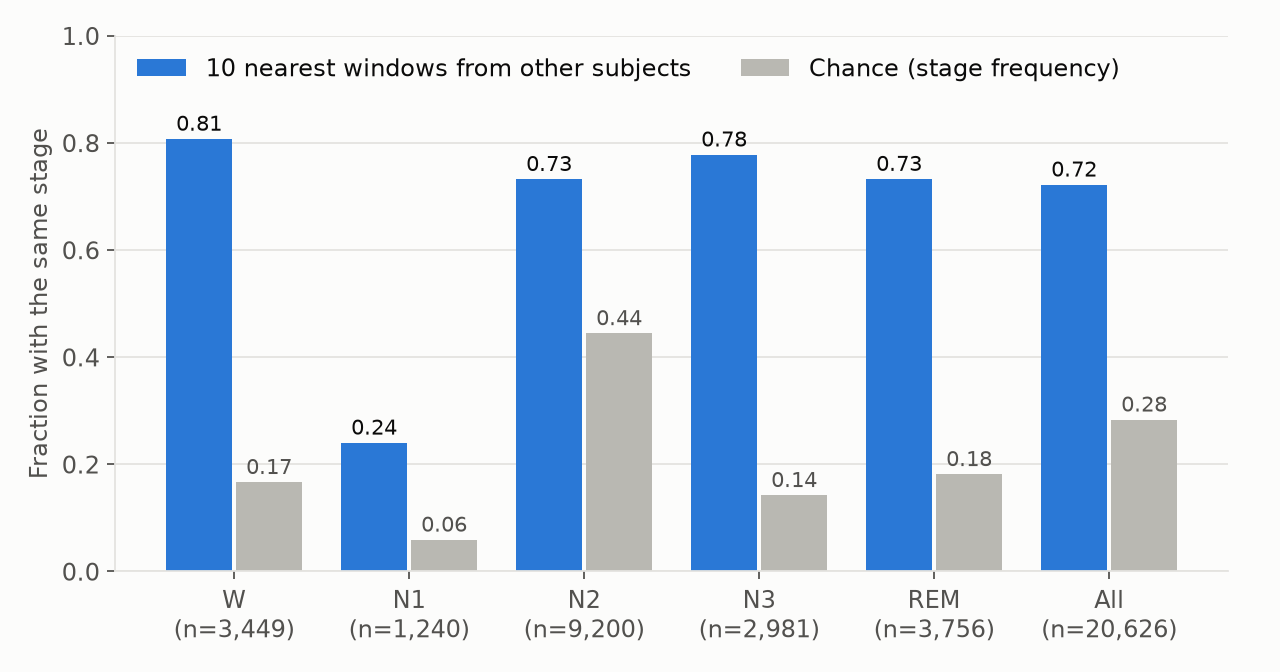
Fraction of the 10 nearest other-subject windows that share the query's stage, against chance, per stage and over all 20,626 windows.
What this shows and what it does not
- Across subjects, the nearest windows share the query’s stage far more often than chance for every stage: 72.2% of neighbours overall against 28.3% by chance.
- N1 is the weak stage: 24.0% of neighbours are N1, against 5.9% by chance, so most neighbours of an N1 window carry another stage.
- The overall figure is weighted by stage frequency; N2 alone is 45% of windows. The per-stage rows are the fairer read.
- In the example, 6 of the 10 neighbours come from night 17. Neighbours can cluster on a few nights, so a search result is not a sample of the population.
- Same-stage rate is one proxy. It does not show that neighbours match on anything clinically relevant, it is not a sleep stager (each window is searched on its own, with no context from neighbouring epochs), and it was measured on the Fpz-Cz and Pz-Oz channels of 20 recordings from one public dataset only.